

Vol.065 — AI Native, the Japan Edition (Day 2): Somewhere Along the Way, the Client Got Ahead of Us

Date: 2026-08-17 | Newsletter
Key Summary
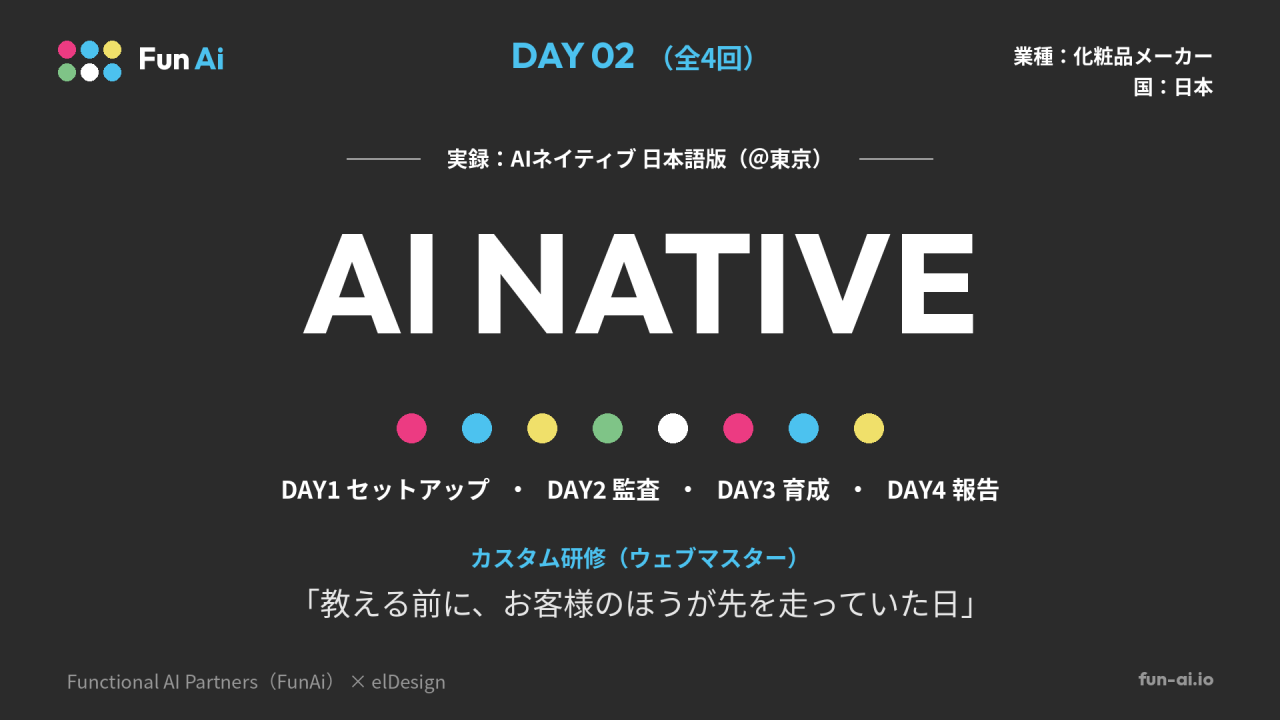
Vol.065 is Day 2 of “AI Native, the Japan Edition.” Day 1 ended with a cosmetics-maker CEO and his colleague lost for words: a text edit that used to take a human web agency a thirty-page brief and about two weeks had taken roughly two minutes. Day 2 opens with Zenta being the one caught off guard. In the few days since, one of the two had gone back and forth with the AI Webmaster and built her first website herself — set up a dedicated project inside ChatGPT’s work mode, moved the AI Webmaster in, and played her way to something genuinely good. She was running well ahead of the plan. So before the scheduled website “health check,” Zenta upgraded the AI Webmaster itself: beyond page updates and image management, it now covers SEO, security checks, drafting customer emails, and tracking contracts and renewal dates — with one promise unchanged, that it shows a draft first and never publishes without a check. The stumbles are recorded too. Having just switched from Windows to a Mac, the day started with “where is the documents folder?” — because in going AI Native the obstacle is usually not the AI but the ordinary tools around it. Then, late in the session, one of them said the project did not seem to be following the instruction file they had handed over. She was right. The file had never loaded: it was too large for ChatGPT’s project capacity, and it did not carry the specific filename ChatGPT recognises as its own rules. Simply saying “treat this document as your rules” does not make it so. That was the day’s real lesson — after handing over instructions, never just walk away; build in a first-day check that asks the AI outright, “did you read it? can you work this way?” A quieter change landed too: the pair had been emailing documents back and forth, so they connected a shared drive, giving the two of them and the AI Webmaster one shelf to look at instead of scattered attachments. The health check itself covered two sites, the corporate site and the online shop, on both SEO and security. Security raised little — it had been built to be shared with their current web contractor. The shop was the problem: product descriptions half-filled, search-critical information and images missing. That was not bad news but a good starting point, because two things became concrete — what it would take to get found, and how much of the missing material the AI Webmaster could fill in itself. With a new cosmetics brand already in planning, the mood turned forward fast: who to reach, what words they should be found by, how competitors present themselves under those same words, which Japanese marketplaces to list on — and with an AI Webmaster, there is no longer a ceiling on how many storefronts you can run, because one operation can grow several at once. AEO — being answerable by AI, not just findable by search — gets woven into both sites alongside SEO. By day’s end they held a first self-built site, one shared workspace between the three of them, and a clear view of what to fix to get found. Defence had turned into offence. The message is simple again: when you hand work to AI, do not hand it over and walk away — ask whether it actually read you. And the best user is still the person doing the job. Today the client was running ahead of the teacher, which is the strongest proof yet of what this series is trying to say. Day 3 next: turning off-the-shelf AI into an AI that understands how this company works — memory, tone, and the rules of how work gets done. Do it simple — your usual work, in your usual words.