


Vol.074 — MEMORY: Why does my AI staff forget key comments I made yesterday!!??

Date: 2026-10-15 | Newsletter · Multi to Single Agent Journey #2 of 10
In the first issue I told you why six AI staff became one, and I said the real problems only started after that decision. This is the first of them, and it is the one that every reader of this series will recognise, because it arrives in the first week of working with any AI staff, whatever structure you run.
Everyone who works with AI staff for more than a week asks this, usually in capital letters. (Hahaha) I asked this on 24 September, and I was confident I knew the answer: Claude again had compressed my long conversation and thrown my decisions away. “This is the entire issue of Claude” But I came to find It was also wrong!! This is one of the moments why I changed how I run the whole operation.
“I will keep all of my decision makings in my record!”
Since 17 September, the day I decided on one agent, I had been keeping a decision journal. It is a page on our internal site, with a master file in the shared folder, and its purpose is simple: every decision I make with the AI staff goes in, with the reasoning — what I rejected, what was argued against it, what I corrected, what I left open. The outcome of a decision goes to its own page; the journal is for the why. I keep it because the question I come back with, weeks later, is never “what did we decide” — that is on the page — but “why on earth did I decide that”.
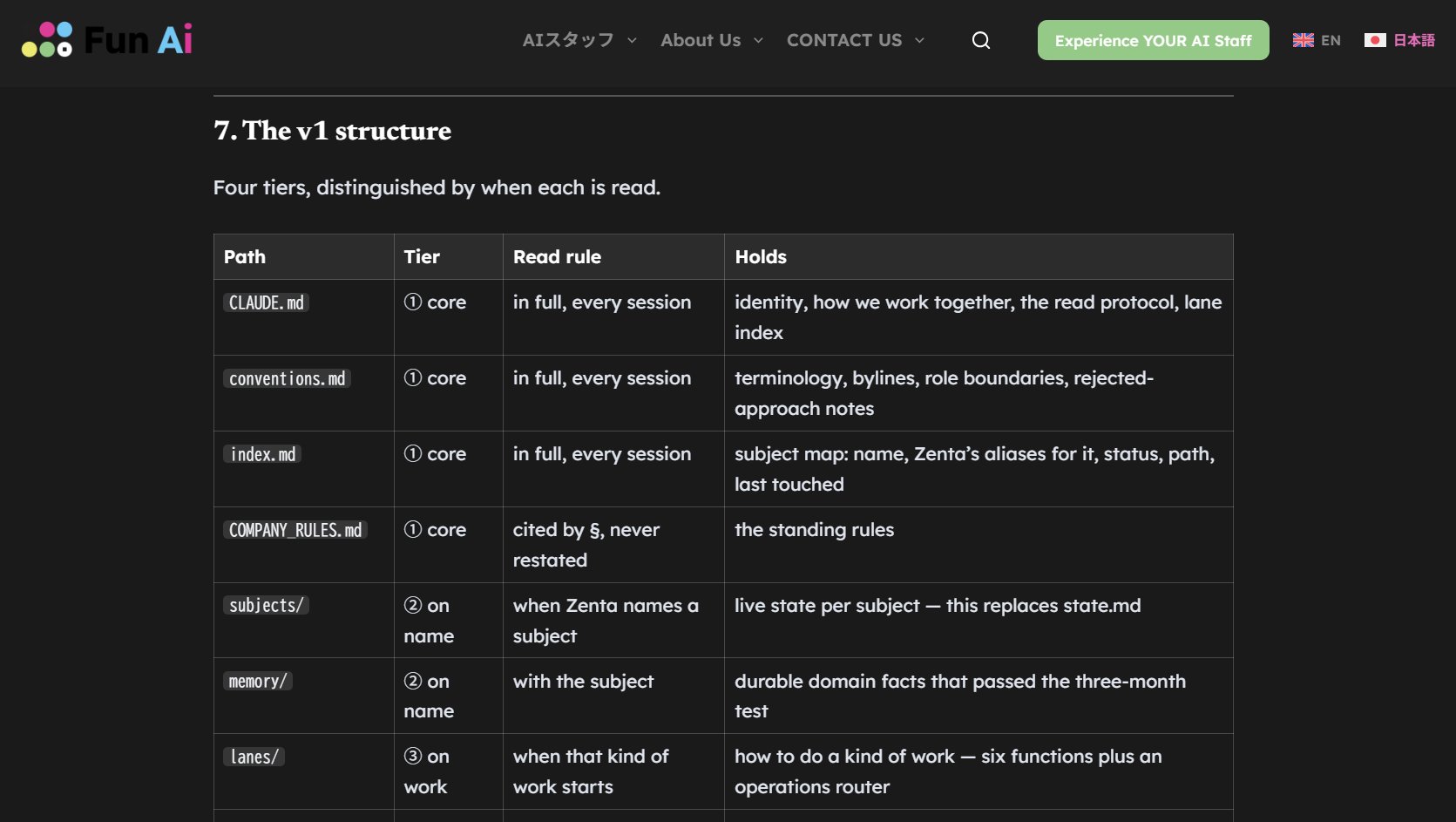
Between 18 and 21 September there were four working sessions, one a day, and each one produced rulings: the file structure for the new agent on the 18th, how memory is logged and retrieved on the 19th, dashboarding and operational execution on the 20th, news selection and the Asia source list on the 21st. Each session published its outcome as a page on the internal site. Four days, four pages, a lot of decisions.
“It's gone. Compressed. This is Claude's whole problem.”
On the 24th I found that the journal had no entry for any of those four days. Not thin entries — none. I had opened it to check something in the 18 September structure decision, and the page went from the 17th straight to the 22nd.
The explanation that came to me first is the one every Claude user reaches for, and I reached for it with some force. A long session cannot hold everything, so at some point the tool summarises its own earlier turns to make room. That is compaction. The summary keeps the gist and drops the specifics — file names, figures, exact wording, the sentence where I explained why. My reading was that those four sessions had each compacted, the reasoning had lived only in the conversation, and the conversation had eaten it. I wrote exactly that to the agent: I am sure Claude compressed during that session, so all memory is gone or compressed; this is the entire issue of Claude.
“I refused” – The agent's first idea made it worse
The agent's first proposal was that I go to the four other chats — one per session — paste in an instruction, and have each of them write up what it still remembered of its own reasoning. A relay, run by me, between sessions.
I refused. My words were that this act was becoming ridiculous for me, and I still think that was the right word. I had built AI staff so that I would do less of this kind of thing, and here was a proposal that I spend an afternoon carrying messages between chat windows on the agent's behalf. The proposal came up three times before anyone checked the one thing that should have been checked first.
It was never written. That was worse — and better
The journal page has a revision history. Ten revisions, going back to the 17th. The agent finally opened it, and not one of the ten had ever contained an entry for the 18th, 19th, 20th or 21st. Two of those sessions had touched the page by a few hundred bytes — a line here, a heading there. The other two had never opened it at all.
So nothing had been written and then lost. The entries had simply never been written.
I want to stay on that distinction, because it is the whole issue. Compaction destroys what exists only in the conversation. It cannot delete what is already on disk. Those four sessions had put every outcome on its own page, and left every piece of reasoning in the chat; when the chat compacted, there was nothing on disk to protect. The failure was upstream of memory entirely. I had been blaming Claude's memory for a filing habit — mine and the agent's.
It was worse, because it meant the four sessions' reasoning was truly unrecoverable; a compacted summary at least leaves a trace. And it was better, because a filing habit can be fixed with a rule, and a tool's memory cannot be fixed by me at all.
Write the why now, or lose it
The rule we made that day is one line in the company rules: a decision is written to the journal in the same turn it is made, with its reasoning, and the session's closing step names the entry it wrote — so a session that wrote nothing shows up as a gap rather than as silence. The rule closes the hole at the only point where it can be closed: the moment of the decision, while the reasoning is still in the conversation.
The four missing entries were then reconstructed from the four session pages, numbered 3.1 to 3.4 so the date order holds, and each one marked as a reconstruction that names what cannot be recovered: the options I rejected in passing, and my own phrasing before the agent tidied it. I would rather have an entry that says “this part is lost” than a clean entry that pretends otherwise.
Two smaller things from the same afternoon, because they belong to the same lesson. The agent had written plausible-looking clock times into the action ledger — the file whose own rule is that every line carries evidence — before reading the clock, twice. The fix was mechanical: the clock is read at the first step of every job, and a time nobody read is not evidence. And the company rules file had been sitting at the wrong version number for a day, understating itself. Small, but all three failures are the same shape: something that should have been written down at the moment it happened was written later, or never.
I had switched memory off on purpose, a week earlier
Here is the part that may sound contradictory. On 17 September, the same day I chose one agent, I had gone into Claude's own memory settings and turned off “generate memory from chats”, keeping only “search and reference chats”. So a week before I blamed Claude's memory, I had deliberately stopped using half of it.
The reasoning was, and is, that for work facts and rulings, files I write and can read are better than memory the tool generates on its own. Generated memory can quietly contradict a written instruction, and it cannot move to another model if I ever change tools. I also knew the cost: every behavioural preference that had been living in that memory — deliver files as cards, never use pop-up choice widgets, hyperlink page names, give me choices before conclusions, do not always agree with me — would revert to default in the next new session unless it was written into an instruction file. I listed them that day as things to carry over.
So the 24th was not one failure but two of the same kind. I had switched off the memory that writes itself, and I had not yet built the habit of writing it myself.
A log nobody has to read is just a shelf
The third thing I learned about memory that month came from the opposite direction: not a file that was missing, but a file that was there and might as well not have been.
Our metrics log — the record of every send, every enquiry, every target — had five owners, because each staff member appended its own lane to it. When the structure was taken apart on 18 September, it was the concrete example used for everything that was wrong with the files: five owners means no writer, and a file that no one is required to read does not get read. It also contained lines that were wrong, and nobody had noticed, because noticing requires reading. On 26 September I retired it — not corrected, not deleted, but closed as it stood with the wrong lines left visible, because a corrected file erases the evidence of how the numbers went wrong, and a deleted one erases the fact that they ever did. Measurement now lives inside the subject file that owns the action, where the person doing the work has to see it.
I added one thing to that ruling in the same breath: I would discuss with the agent whether a metrics view was still necessary. Retiring the file was not a ruling that measurement does not matter. It was a refusal to keep a container alive in the hope that something would fill it.
So which memory should you trust?
If you want your AI staff to remember what you said yesterday, there are, put simply, two memories to choose from, and they are not equal. The memory Claude generates on its own suits one session — one project, one agent — used for one job, with no other session to link to and no need to ask why. For that reason it does not suit work that carries on into the next day. Your own memory files are the better choice when the work or the conversation continues, when the decisions in it have reasons, and when you want to look back at those reasons and keep improving. The obligation that comes with them is writing the reason at the moment you decide. (That part is hard. Nobody likes it, and it is the habit I used to skip.) I chose the files. The day I stopped blaming compaction was the day my memory files first started working the way they should.