

Vol.051 — Is Your Business “AI-Adopted”? That’s Like Asking If You’re Healthy.

Date: 2026-06-25 | Newsletter
Key Summary
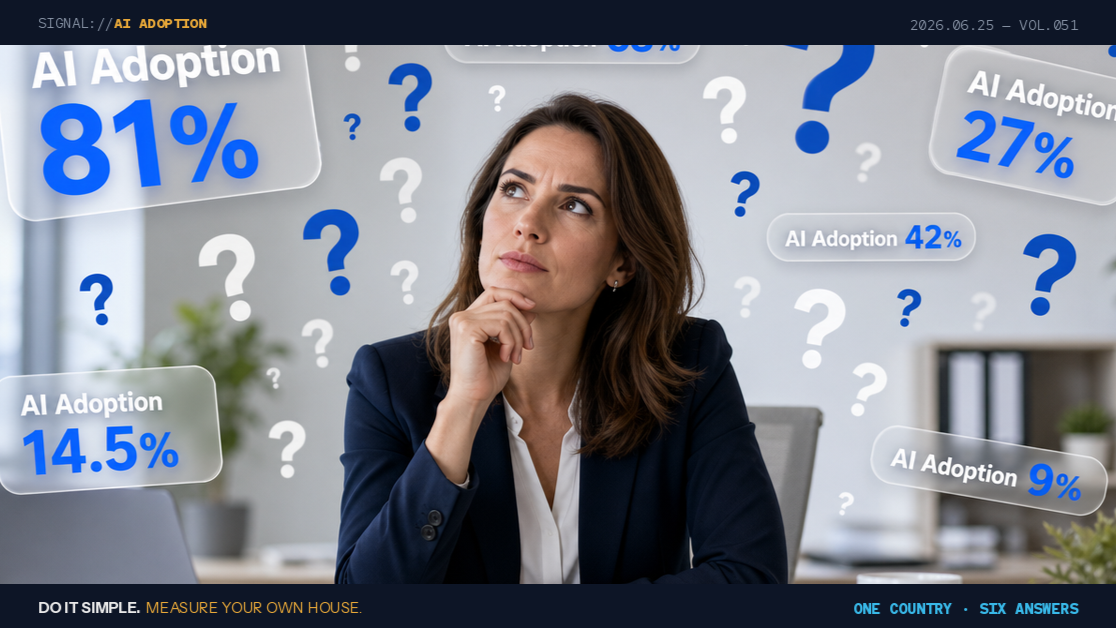
In Vol.051, Zenta tackles a question a business owner put to him last week — “Are we behind on AI adoption?” — by going looking for the number, and finding chaos. In Singapore, the government (IMDA) says 14.5% of SMEs have adopted AI; the same year, Amazon’s research says 48%. In Malaysia, Amazon says 27% while the accounting software firm Xero says 81%. Same countries, same year, same reality on the ground. Which is correct? All of them, and none of them — because there is no agreed definition of “AI adoption.” It is a single yes-or-no survey question, and the answer depends entirely on how you ask. “Have you adopted some form of AI?” gets near-universal yes; “Have you scaled AI across your whole organization?” gets mostly no. It is exactly like asking “Are you healthy?” — everyone answers, nobody means the same thing, and a low bar produces a big number. There is a second hand on the scale, he warns: look at who publishes the figure. A company selling an AI upgrade can tilt it either way and both sell — “everybody’s already adopted” makes you panic you’re behind, “only 10% do it properly” makes you buy the premium tier. The part that made him laugh, then respect them: economists at the US Federal Reserve and Harvard studied the measurement problem itself and found 43% of workers say they use AI on the job while the main firm survey said 5–7% — an eight-times gap, not secret usage but broken surveys. The smoking gun: in November 2025 the US Census Bureau changed one phrase, from AI used “in producing goods or services” to “in any business function,” and the measured rate nearly doubled overnight, 10% to 17%, with no real change. Their honest conclusion is that these surveys “measure AI adoption in ways that are difficult to compare directly.” So if the Federal Reserve can’t cleanly compare adoption across organizations, what chance does an owner have against a number on a LinkedIn slide? Zenta’s whole message: look at one organization only — yours. Comparing your business to someone else’s published rate is saying “She is healthier than me” without ever seeing her check-up. Set your own definition, count task by task where AI genuinely helps and where it quietly does not, and compare yourself to who you were last quarter. This matters more in ASEAN, where a scary headline percentage pushes owners to buy fast and think later, paying the tax twice. Do it simple. The only AI adoption rate worth knowing is the one you measured yourself — everyone else is just holding a different ruler.