

Vol.068 — AI Native, the Japan Edition (Day 4, Final): On the Last Day of Training, the Talk Turned to Hiring a Second AI Staff

Date: 2026-08-29 | Newsletter
Key Summary
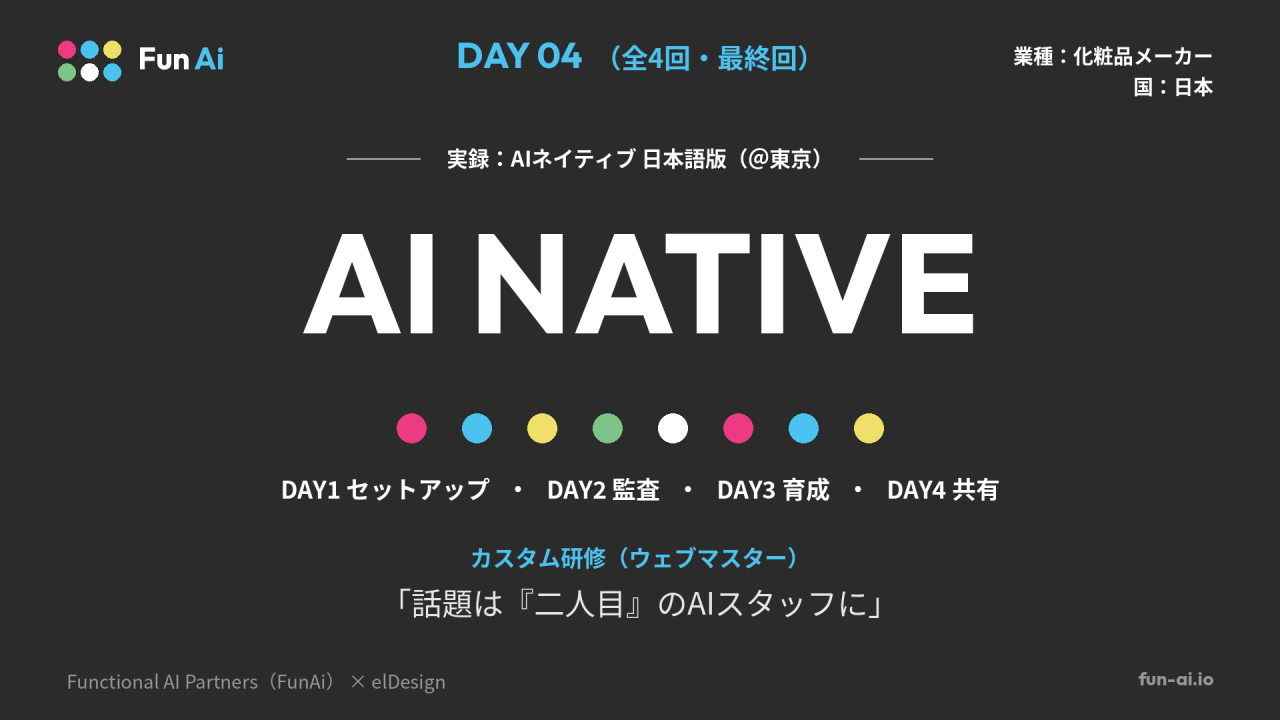
Vol.068 closes “AI Native, the Japan Edition” — the fourth and final session with the CEO and a colleague at a Japanese cosmetics maker. Day 1 ended in silence when a text edit took two minutes instead of two weeks; Day 2 had the client running ahead of the teacher; Day 3 was about how to raise an AI rather than what it can do. The final session was run with everyone in the same room, and Zenta notes how much that mattered: setup work is where the last step trips you up — permissions, sharing, verification — and on a video call those turn into homework, while in one room they get finished. Everything needed was completed that day. The goal was explicit: connect the two participants’ folders so that instead of each running a separate AI Webmaster, they share one, through Google Drive. Only then does the AI Webmaster become a team member rather than a personal tool. The hard part was not the sharing but synchronising the contents. The AI Webmaster has an instruction file, a memory file and a status file, and each participant had been holding her own copy. Connecting them as-is would just leave two copies drifting apart until nobody could say which was real, so they were rebuilt as one set that both people look at. The instruction file was rewritten too, with two additions: that it is shared between two people, and that it must always know which of the two it is currently talking to. A human assistant does that untaught; an AI has to be told in words, or work told to one person bleeds into the other’s. What the pair now share is not a folder, Zenta writes, but a colleague — the landing point of the Day 2 question, “how do you two pass documents between you?”, answered then with “we email them.” Then came the question he was most pleased by: “we understand AI can draft a business plan — can we ask this AI Webmaster to do it?” Yes, he said — but as a separate project, in a separate folder. Keep this one on web and design, and hire a second AI staff for finance. The reason is the memory file: roles should keep their memories cleanly apart, because what accumulates as a web manager and what accumulates as a finance manager pay off in completely different situations. Separated, each memory deepens inside its own role; mixed, judgement collides inside one head — and finance sits awkwardly against other roles in particular. Put design and accounting into one person and that person fights with themselves every day. What made the question satisfying was that the client had already moved from “using AI” to “adding AI staff.” From there, how to improve the exchange itself. Language ability in generative AI is improving fast, so the growth room is now on the human side. Design is the hard case: saying what you like and why is difficult even with another person, and harder in text alone — so you have to supply non-verbal means. Zenta calls this Visual Alignment: show liked and disliked examples side by side, mark what differs, and keep the whole exchange in the preference file. It also cures the Day 3 habit of answering “yes” to everything — with material to refuse with, people can refuse. “I prefer this whitespace, and here is why” is sayable where “it doesn’t feel right” is not, and only once you can say no does the AI take on your colour. He closes with the through-line of all four sessions. AI staff need managing. Responsibility for what an AI staff produces sits with whoever gave the instruction — “the AI got it wrong” means nothing to a customer or a supplier. So before asking whether it is convenient, ask whether it is properly managed: be the one riding the AI staff, not the one being ridden. Three weeks ago the pair outsourced a one-line text change. Now they share one AI staff and are discussing a second. What grew was not the tools but how they delegate and how they manage. The training ends here, but the company’s road to being AI Native has only just started. Do it simple — your usual work, in your usual words.