


Vol.069 — AI Native, the Japan Edition (New-Hire Onboarding): Six Weeks That Started With “I Wish I Could Photograph All the Receipts at Once”

Date: 2026-09-12 | Newsletter
Key Summary
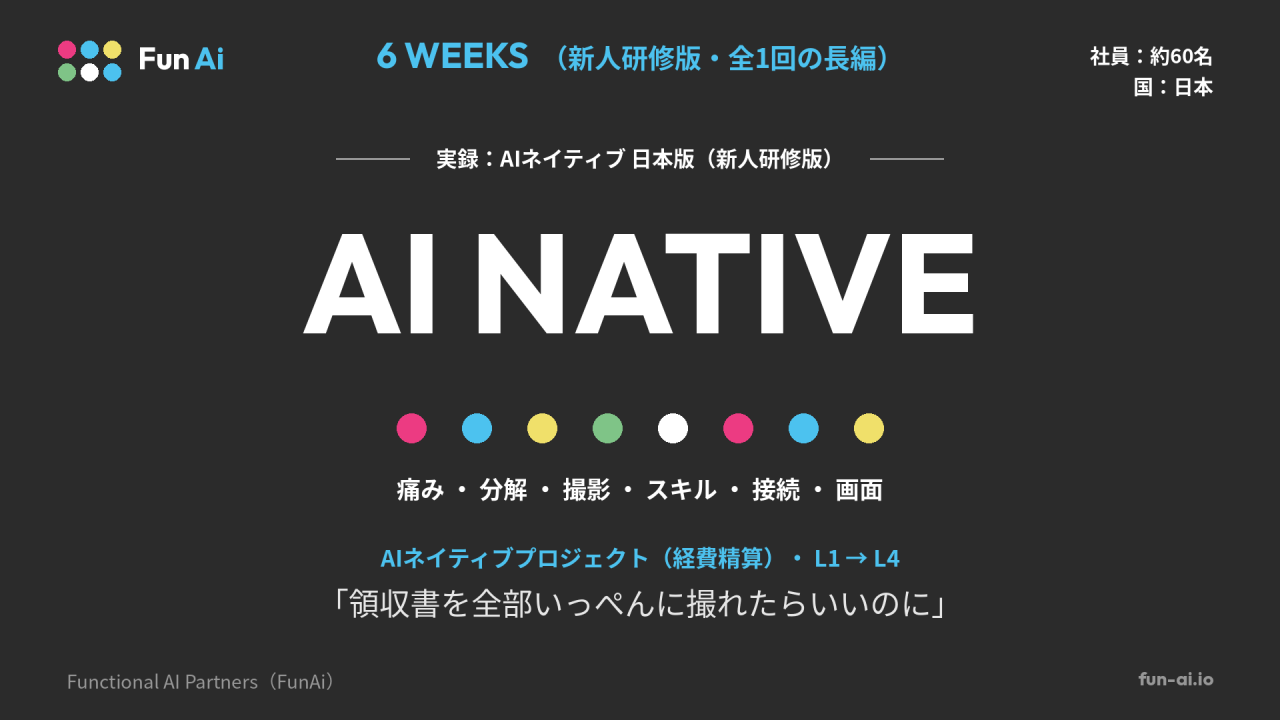
Vol.069 is the fifth instalment of “AI Native, the Japan Edition” — and a different company from the cosmetics maker of the previous four. This one has about sixty staff, the AI Native project is nearly complete, and instead of a weekly diary Zenta writes the whole six weeks as a single long piece. The lead is a brand-new hire. Her first assignment from the CEO was ordinary onboarding — interview people, understand one process, try to improve it — with “learn some AI along the way” added on top. The process she picked was expense claims, chosen because it is the one thing every single person does for themselves: improve it and the effect reaches the whole company, and a new joiner with no internal standing can still ask anyone about it, because everyone is a party to it. Her declared starting point on the firm’s pre-training survey was L1 — occasional use as a search substitute, free tier, nothing more. What follows is the record of an L1 person building an L4 thing. It began with a remark from the CEO’s secretary, who spends every month photographing receipts one at a time and uploading them to a cloud expense system: “I wish I could just photograph all the receipts at once and be done.” Week one turned that pain into a number. Thirty minutes for the lightest users, two hours for the heaviest; across sixty people, roughly 2,000 minutes a month — time that contributes nothing to revenue and nothing to output. Nobody had ever added it up, so nobody had felt it. The target was set there: cut it by more than eighty per cent and give 1,600 minutes a month back to the company. Week two took the existing cloud expense system apart, and what it revealed was that the system is designed around humans operating it. Humans make mistakes, so human-checking-human steps are built in two and three deep. Zenta’s image for it is a factory line assembling televisions: everyone queues up on the line every month — and what the line produces is not a television anyone can sell. Week three was the experiment of photographing receipts in bulk, and it came with a constraint that could not be worked around: Japan’s electronic bookkeeping law sets a scanner-storage requirement of at least 200 dpi. “All at once” is worthless unless “all at once” still clears that bar. Ten receipts in one frame, twenty in one frame; have the AI cut them apart; inspect the resulting image quality. The answer, after several rounds, was that an ordinary smartphone clears the requirement at fewer than ten receipts per shot, taken close. Week four is the one Zenta likes best. She opened her own Claude Cowork project and talked to Claude about what she wanted to do, in what order, and when — and when that conversation had run its course, he said one sentence: “now ask it to make a skill out of the workflow you just agreed.” That produced expenseclaim.md. Then she explained what she does in her head when entering travel costs — from where to where, by what means, whether it overlaps her commuter pass — on condition the result match the existing system’s arithmetic, and that produced travel_calculation.md. When she typed “/” to call the first skill she had ever built, she said it gave her goosebumps; that she had never imagined doing something like this; that it felt like being a programmer. Week five asked where the data actually goes. Having the AI read receipts and travel costs into a tidy Excel file solves nothing if someone then keys that Excel into somewhere else. There were two candidate destinations — the accounting cloud software, or the existing expense system — and here they got greedy: if the AI can take over every double-check the expense system provides, is there any reason to route data through it at all? The accounting software turned out to have bulk upload, an API, and even MCP. So the output was rebuilt in the accounting software’s bulk-upload format and wired straight in. Decision: the expense system is not in the path. Its monthly subscription goes too. Not fewer steps on the assembly line — no assembly line. Week six was the screen the staff touch, on the principle that however good the machinery behind it, nobody uses a screen that looks difficult. Using the old system’s screen as the model, they stripped out every function that was no longer needed. Employees now do four things: photograph receipts in batches of fewer than ten, drop them in their own folder, log in and enter travel costs and check the amounts, submit. Every double-check and error check is done by the AI, and the accounting reviewer is shown only the places where the AI’s confidence fell below ninety per cent — humans look only where the machine hesitated. She calls the screen “a website,” which is not technically wrong. Zenta is honest about where it stands. Company-wide rollout is still ahead. Reading receipts and travel costs and pushing them in bulk into the accounting software is already running for real; what is being worked on now is the reviewer’s side of the screen. How far the 2,000 minutes actually fell will be reported with numbers once the new flow has been through several month-end cycles — he commits to a follow-up in two or three months. But what she built is already in a form that can be embedded in the workflow and handed to the team, and that is the definition of L4. He closes on what the six weeks confirmed for him: the AI Native project is not a project where his firm builds things on the client’s behalf. It is a project where the client’s own staff learn to build small improvements themselves. The person who knows the work is the person doing the work; once that person can build, the improvements continue after the consultants have gone home. The job is to plant seeds — and the people who learn, and enjoy it, go on to sow the next ones. This time, new-hire onboarding and a first step toward AI Native fitted into the same six weeks: someone who had just joined rebuilt a process touching every person in the company, and it started with a secretary wishing she could photograph the receipts all at once. Do it simple — your usual work, in your usual words.