


Vol.035 — Building a Responsible AI Agent: Same Standard You Hold Your Staff To

Date: 2026-05-29 | Newsletter
Key Summary
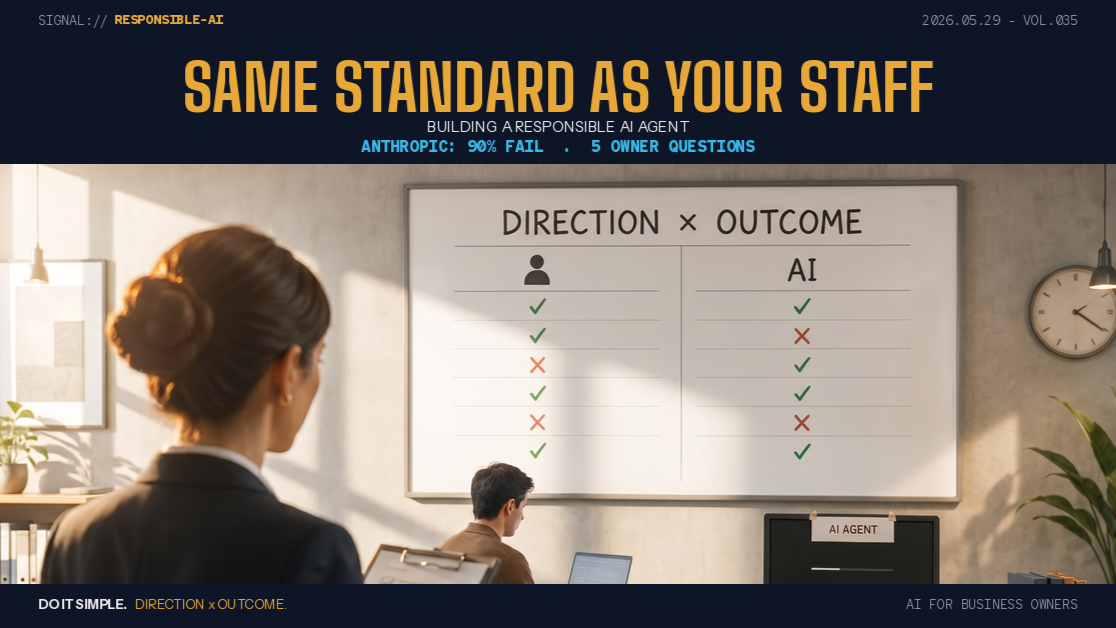
Anthropic’s paper “Trustworthy Agents in Practice” reported that around 90% of non-coding AI agents fail in real-world deployments. The instinctive read is: wait until the failure rate drops. Zenta’s read is: that’s the wrong scoreboard. Human staff hallucinate, misremember, forward wrong documents, and leak data — and nobody measures them against a 100% bar. The right measure is direction and outcome: is this agent moving the business forward in a clear, visible way? Anthropic’s five vendor principles (human control, alignment, security, transparency, privacy) translate in practice to five Monday-morning questions any business owner can ask before deploying an agent: Can I stop or redirect it? Does it understand what I’m actually trying to achieve? Will it leak data? Can I show an auditor what it did and why? Whose data is it touching, with what permissions? The one genuine asymmetry between humans and AI agents is blast radius — a single human error stays local; an AI error at speed and scale can touch thousands of records before anyone notices. Responsible design means building kill switches, rate limits, and human-in-the-loop gates at irreversible actions, not as a reason to wait but as the condition under which you deploy confidently. For Singapore, Malaysia, Vietnam, and Japan specifically, Zenta notes the checklist is not optional: PDPA Sections 13 and 26, Vietnam’s AI Law in force since March 2026, and Japan’s nemawashi culture all require transparency and human control as structural baseline expectations, not enterprise-only extras. Do it simple. Direction and clear outcomes — same standard your team is held to.